Why are designers suddenly obsessed with brand guidelines?
Inconsistency isn’t something you fix later. You prevent it from the start.
This mindset has guided how we work at Moises. Design was never a layer added later, it helped define direction early on, influencing decisions and setting the tone for how the company operates.
As the company grew, that same level of care had to scale with it. And that's why documentation was part of that effort. Rather than defining the brand through fixed buzzwords, we create room for tone to shift while keeping a stable foundation. One that gives the work clarity and confidence as it evolves.
That feels even more relevant now. AI is expanding what’s possible, but also making it easier to lose direction. A brand guide becomes less about control, and more about clarity: what stays, what goes, what moves forward.
Over time, that clarity isn’t defined in a single place. It emerges through what a company creates, and how people use it. Without it, decisions slow down and lose direction. With it, they move forward.
What holds a brand together
What came first, the chicken or the egg?
A brand guide doesn’t come first. And it’s not built in isolation either. It takes shape as things start influencing each other, gradually, sometimes inconsistently, until patterns begin to stick.
We remember the days when our team spent hours digging through stock libraries, trying to find the “right” image. Entire afternoons forcing things to fit. We tried everything, including image generators. Something always felt slightly off.
Not wrong. Just not true.
The question shifted: how do you represent something as specific as making music in a way that actually resonates with people who do it?
At some point, it became obvious that simulating it wasn’t enough. Stock images of people “playing” instruments: perfectly lit, perfectly staged, rarely held up.
Not because they were incorrect, but because they lacked intention. Musicians notice that immediately. The way someone holds an instrument, posture, timing, it’s all part of their craft.
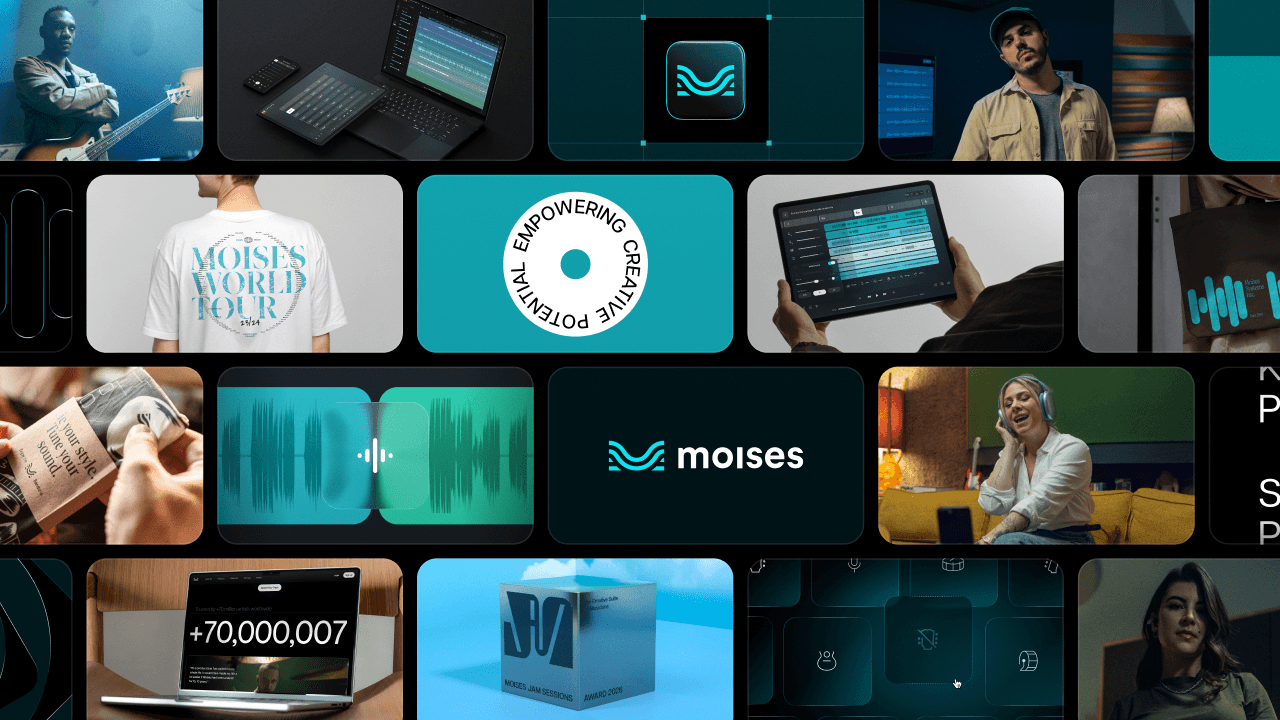
That’s when photography stopped being a supporting layer and started shaping the system. It began influencing how compositions behave, how color is used, how elements come together.
Eventually, separating content, graphics, and photography stopped making sense. Everything started operating as one. Like music, it’s less about individual parts and more about how they harmonize together.
You’re still part of the band, even when you’re not the one playing.
This idea always stayed with us. Design isn’t something that happens at the end. It moves alongside everything else. Even when it’s not producing something visible, or leading a specific delivery, it’s still there, influencing decisions, shaping direction, affecting the outcome. And at some point, you stop designing elements and start designing relationships.
When growth changes the rules
Founded in 2019, Moises now reaches over 70 million artists around the world. As the product grew, so did the number of people building, communicating, and shaping how the brand shows up across different contexts.
That shift becomes even more visible when you care deeply about the details. It shows in how we build.
Music is a universal language, and from day one we prioritized accessibility and localization. From supporting over 35 languages with an internal localization team, to building and training our own LLMs, to creating our own icon library and even producing physical awards for our Jam Sessions global contest.
These aren’t isolated decisions. They’re part of an ongoing effort to keep the experience coherent as it expands.
Over time, that level of care has also been recognised externally. Moises was selected by Apple as iPad App of the Year in 2024, and named a finalist for the Apple Design Awards in 2025. We were also recognised by Microsoft as Best Music App at the Microsoft Store Awards 2025, and earlier, in 2021, Moises was named Best App for Personal Growth by Google Play.
Consistency begins to matter in a different way: as continuity. Something people can recognize, trust, and return to. And guidelines, in this sense, don’t lock a brand in place. They give it enough structure as a live organism that grows without falling apart. That’s where the Moises Design Hub comes in.
A system for what’s next
The Moises Design Hub took shape over time, growing alongside the company itself. What started as an internal need for designers and developers became a shared effort across product, content, audiovisual, customer support, employee experience, and beyond. Shaped through conversations, curation, and people who genuinely care about getting it right.
And all of this happened in parallel with everything else. Product releases. Campaigns. Partnerships. Events. It couldn’t be rushed. It had to be built within that reality. That time mattered.
Our design is guided by four core principles: Human, Universal, Simple, and Efficient. And by a belief that Moises is made “from musicians to musicians.” This has always shaped how we operate. We talk to artists. We listen. We prioritise what they actually need. That same approach defines how we design. It comes from use, from feedback, from understanding what feels right to the people we’re building for.
You can’t guide without knowing the path. And you don’t know the path without walking it first.
What came out of this isn’t a static manual. It’s a system that reflects how we work and makes the brand easier to use for everyone involved, not just designers. It reduces friction. It gives direction without over-defining it.
We’re proud to bring the Moises Design Hub into the world. A digital space where ideas, creativity, and innovation come together to guide how we build the best experiences for musicians around the world.
Now live at design.moises.ai