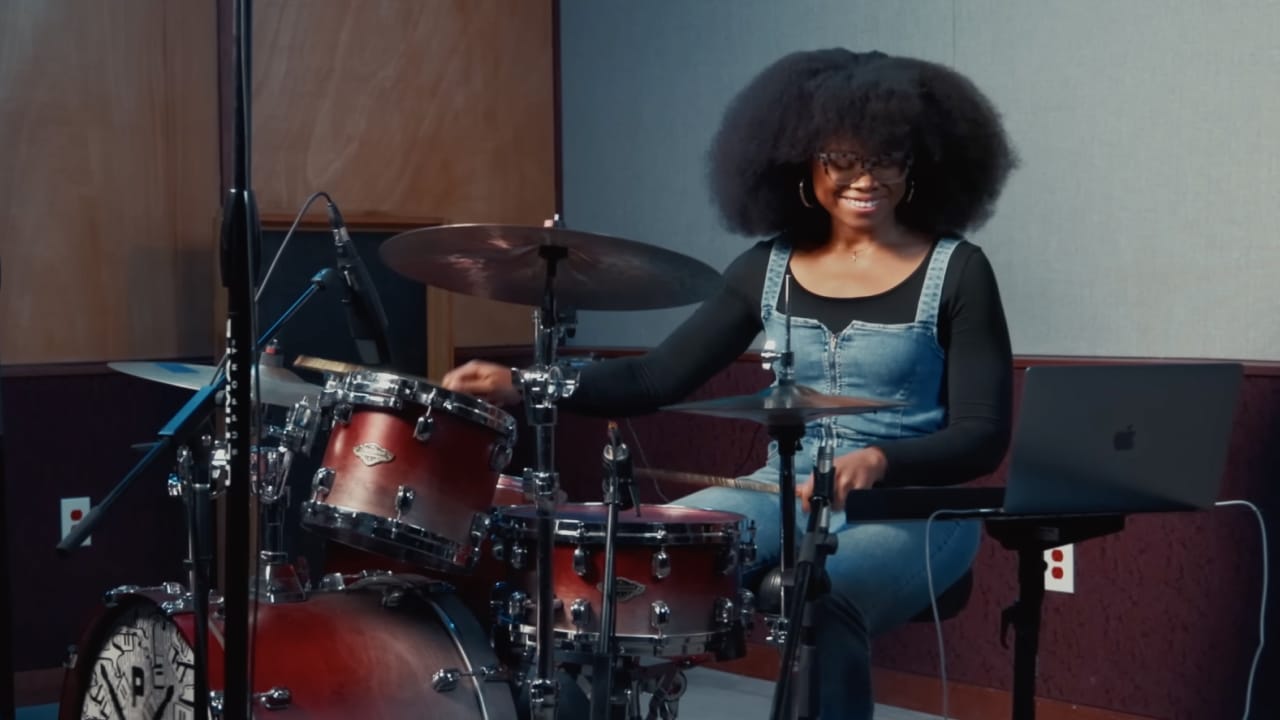
The groove buried in the mix
We've all been there: you're trying to learn a song, and there's so much going on you just can’t hear what's happening. There are horns, guitars, keys, and so much chaos that even a simple part is difficult to learn because it's buried in that mix. When learning a new groove, all those layers might be hiding the details of what the kick, the snare, and the hi-hat are doing. Luckily, there's a quick, easy way to break down the song, separate all of its elements, and surface exactly the parts that you are interested in.
The turn: break it down piece by piece
Moises allows you to separate part by part of a song you're working on and isolate only what matters. For example, when you're studying a drum part, you can separate more than just one basic drum track lumped together.
With Moises, you can split each individual drum on its own, like the kick, the snare, the hi-hat, and others. That is the best way to have a real understanding of the exact role each element is playing in the song. Add in features like the Metronome, the Count-in, and the Loop Sections, and you can figure out an entire song a lot quicker than just looping the whole mix and hoping it clicks.
Listen to the whole song, then to each drum on its own
When learning a new song, I always start from the top and just listen to the whole thing first. For example, there was this tune I was working on, and the intro alone told me something groovy was coming. But before I got ahead of myself, I wanted to actually hear what the kick or the snare were doing right in the middle of that crowded mix.
So, I soloed the kick to feel what was hiding beneath all those layers.
Slow it down until it's not rushed
Once you know what's most important when you're learning a new pattern, you slow it down. Talking about that song I was learning, it sits at 113 BPM, so what I did was I brought it down a few notches at around 100 BPM. Not too slow, but just enough that I wasn't feeling rushed. Right away, I felt less nervous, and I could also slow down mentally, which allowed me to hear even more of what was happening.
Loop straight to the part that changes, and make it yours
Let's say there's a specific part of the song you're trying to nail down. Moises has a Loop Sections feature you can turn on, and it recognizes the different parts of the song automatically. In that song I gave as an example, I noticed a groove switch-up in the chorus, so I dialed straight into it, turned the Loop Sections on, hit the spacebar, and it was all there.
I turned on the Smart Metronome for a clearer marker of where the tempo actually sits. Since it was already mapped out for me, it was easy to isolate everything again and to really listen to every detail. Once I felt like I had the basic tempo and the basic pattern down, I decided to put a little personality into it, my own Pocket Queen interpretation, not just a carbon copy of the record.
Zoom in on the funky lick
The chorus felt solid, but there was one lick that caught my ear and made me want to go back and review it. So, I turned Loop Sections back on and went straight to it. Once again, I stripped out whatever wasn't necessary (but I kept the bass guitar for context), and brought the tempo down to about 100 BPM. The difference was that, this time, I started things off with a Count-in.
The best part is that I could take it down phrase by phrase. Letting the Count-in bring me in fresh each time allowed me to work on each piece on its own. First, I played it exactly as it was, just to know precisely what was happening. Once I had that, I loosened up and added my own pizzazz, a little more PQism folded into the composition. It ended up being pretty much the same part as the original, just with more of me in it.
The real moment of truth
Finally, it was time for the final test: I muted the drums entirely. The kick, the snare, the hi-hat, the toms, the cymbals, all of it (though I kept the percussion in since it added something nice). Then, I played along live with the rest of the song to see if I'd actually pass the test.
We just learned an entire song
And there it is, we just picked apart an entire song using Moises, piece by piece. So, the next time a groove feels buried under the mix, or you're not sure you're really nailing a part, don't just keep replaying the whole track and hoping it clicks. Bring it
Try it with your own track. Try Moises free!