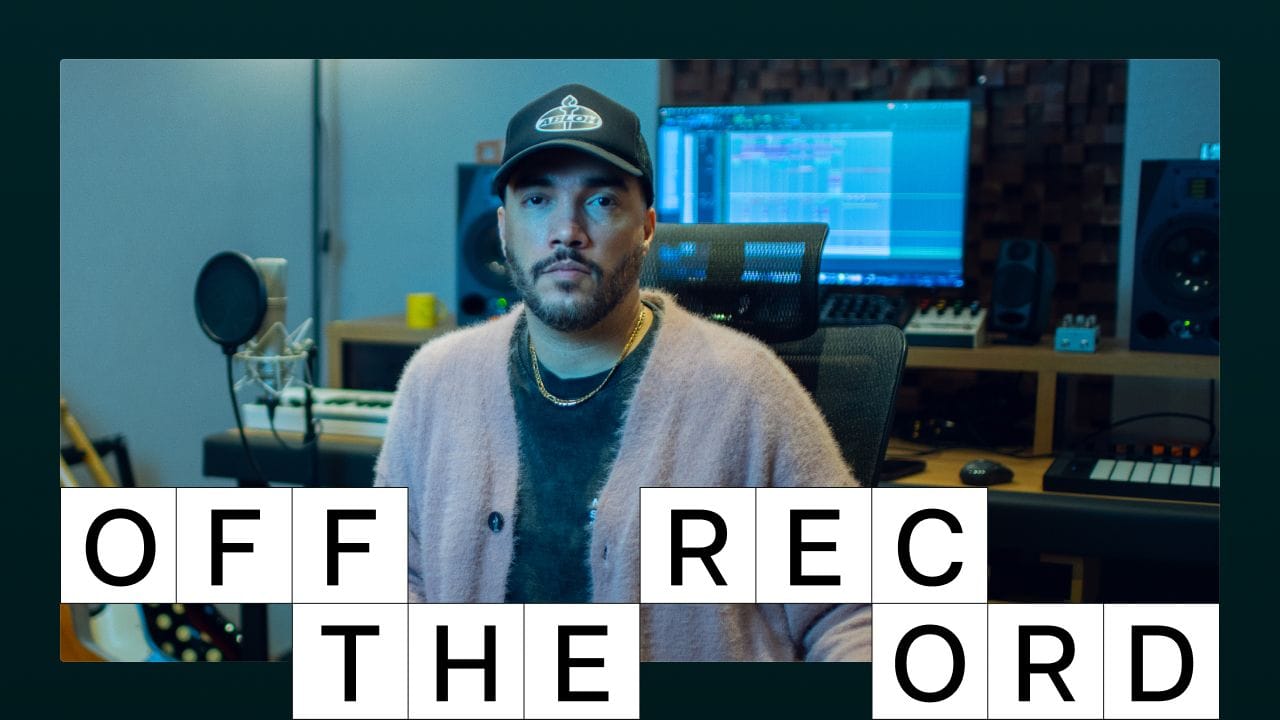
Music careers are rarely built in straight lines. Most breakthroughs happen off camera, in small rooms and private moments where ideas are tested long before they reach a stage or streaming platform. Off the Record exists to reveal these hidden layers: the habits, doubts, influences, and instincts that shape musicians and producers across decades.
The series looks beyond polished results to document how artists navigate challenges in their own way. Every guest brings their own path and their own set of tools, and each episode captures the real decisions behind the work.
Episode eight features Nave Beatz, a Latin Grammy winner who helped shape landmark projects including Emicida’s AmarElo and Marcelo D2’s explorations into new territories. From the gritty, sample-heavy beats of the 2000s to genre-bending experiments, his approach is built on curiosity, experimentation, and a deep respect for Brazilian musical traditions.
Nave learned by listening long before he learned by doing. He views the producer primarily as a decision-maker—someone whose job is to filter infinite possibilities into a cohesive vision.
The following sections dive deeper into the lessons that define his career, offering producers and musicians a closer look at how he builds ideas, navigates uncertainty, and turns experiments into fully formed work.
Learning by Doing: How Nave Became a Producer Through Trial and Instinct
Formal training has its place, but many influential producers develop their craft in working environments, under real pressure.
Nave’s path shows what happens when curiosity becomes a discipline. Instead of entering music through conservatory routes, he landed inside the studio long before he understood the technical rules.
The urgency of those early opportunities forced him to evolve fast, shaping a working method driven by instinct, listening, and a willingness to fail publicly if that is what the process demanded.
As Nave explains:
“I wasn’t that guy who worked as a studio assistant, or played an instrument since I was a kid or a teenager. I stepped into a world where I needed to know a lot off the bat. It was like: doing what I could manage, and learning as I went, you know?”
Over time, this hands-on approach became a philosophy. Instead of chasing perfection, Nave built his craft on daily practice. He never positioned himself as someone who had “arrived”. He remained a student by choice.
“I feel like, even now, every single day I’m learning something new.”
A Door Opens: Why Marcelo D2 Became a Defining Catalyst
Every career has a moment that feels like a turning point. For Nave, this moment arrived when a homemade demo unexpectedly reached Marcelo D2. The call that followed not only changed his professional path but also validated his belief that he belonged in music.
It is one thing to dream about producing. It is another to be recognized by an artist who helped define an entire era.
“That demo ended up in D2’s hands. I thought it was a joke when he called me. And a year later I was already out there with him. And I’ve been working with him ever since.”
This early connection came at a time when Nave was still unsure if he should pursue music full-time. D2’s interest became the signal he needed. The message was simple: follow the work that feels alive.
One of Nave’s most innovative contributions is the creation of the “New Traditional Samba” alongside Marcelo D2, Kiko Dinucci, and Mário Caldato. The process blended deep research, reference listening, archival samples, and the personal textures of each collaborator.
The aesthetic combined Brazilian rhythms with influences from R&B, alternative production, and layered textures. Several collaborators shaped the final sound, each adding a distinct emotional layer.
Memory, Listening, and the Foundations of a Producer’s Repertoire
Nave’s musical identity did not begin in the studio. It began at home, with vinyl on weekends, radio in the kitchen, MTV after school, and siblings who played Nirvana, Soundgarden, Queen, Lou Borges, Djavan, and Stevie Wonder on repeat. Long before he understood how a bassline was recorded, he felt its emotional effect. This early immersion shaped the instincts that would later guide his decisions as a producer.
“I think it was a mix of all that. You kinda grow up finding genuine pleasure in listening to music, you know? And I still have that—just stopping to listen to a record, putting a vinyl on the turntable… It just feels good to do that.”
As he grew older, listening shifted from something he enjoyed into something he studied. What once felt intuitive became a conscious study of arrangements, textures, and timbres. Even so, a part of him still returns to childhood when he hears the artists who shaped those early memories.
“For anyone who wants to be a producer, having a repertoire is essential. Listening to as much music as possible.”
Underground Roots: How Aesthetic Identity Shapes Every Project
Nave often describes himself as an artist from the underground who moves through mainstream spaces without losing the perspective that formed him.
His early fascination with Madlib, J Dilla, Premier, Zegon, DJ Nuts and New York’s gritty production aesthetics created a foundation that still informs his work decades later. This sensibility remains present even when he collaborates with major artists or explores commercial genres.
“Nowadays, I see myself as an underground producer who moves through the mainstream.”
This identity becomes a filter for decisions. Even when a project calls for a cleaner or more polished direction, he carries elements of the raw textures and free timing that marked the underground era of the late 90s and early 2000s.
“Madlib, for example, influenced me a lot when it comes to texture—so much that sometimes it’s actually hard for me to produce a track that’s more pop. His sound is so stuck in my head—that dirty, super‑compressed, vinyl‑sampled thing… So my whole approach to music kind of comes from that place.”
Texture, Dirt, and the Emotional Weight of Imperfection
One of the defining aspects of Nave’s aesthetic is his relationship with texture. He gravitates toward vinyl noise, saturation, compression, and analog “grain”. These are not retro gestures. They are emotional tools. A slight crackle or subtle distortion can change the way a listener feels a chord or melody.
“It’s instinctive. I start layering stuff and it just becomes my sound. So vinyl grit and compression are always gonna be there. Or tape dirt. I always push it a little past the edge, because I like those characteristics.”
Nave describes this as something that grabs the ear in ways most listeners can’t explain. The psychological impact of these details creates warmth, depth, and familiarity.
“That seasoning right there, that analog gloss… it catches you, and you can’t really say why, right?”
Experimentation as Discipline: Working Without Depending on Inspiration
For Nave, creativity is not a mood. It is a method. He rejects the idea that a producer must wait for inspiration. Instead, he relies on a daily practice of experimentation that keeps the process moving even through uncertainty.
“I’m not really into that idea of being inspired or not inspired. I like that concept Tom Zé talks about: he wakes up every day and just does his work. Makes a bit of music, keeps going, keeps going… That’s how I understood I had to work to make it in this industry: you sit down and make it happen.”
Ideas often emerge only after many attempts. The important part is to keep trying, testing, shifting, reframing, and reacting to accidents.
“Sometimes you’re out of ideas, sometimes things aren’t very clear in your head, and you have to keep experimenting, trying to find an idea—until at some point your ear catches something and goes, ‘Damn, this is interesting.’”
And sometimes, the unexpected becomes the highlight.
“It’s trial-and-error work, too. You keep testing until something interesting happens—an accident, right? Embracing the accident is important too, you know? Sometimes the accident is actually more interesting than the original intention.”
Each Project as a New World: Avoiding Repetition and Honoring Identity
Nave never reuses formulas, even when a previous project was successful. Repetition feels hollow to him, and he prefers to frame each album as a unique creative world with its own rules and references. This mindset keeps his catalog evolving and prevents him from falling back on habits.
“I have a problem with feeling repetitive; it makes me uncomfortable. I can’t do one thing and just stick with that thing, you know?”
This attentiveness extends to every collaborator. If an artist brings their own aesthetic or cultural background, the project must reflect it authentically.
“Every artist is their own artist, and every project is its own project.”
Creative Boundaries: Limitations Can Lead to Authenticity
Throughout his career, Nave has learned that defining boundaries can make the creative process more focused and effective. Limiting gear, textures, references, or instruments gives a project a clear personality and often leads to more original outcomes.
“Setting boundaries around a concept. I think more clearly when I start defining things, and that lets me bring out the best in myself so I can try and bring out the best in the artist.”
These limitations help maintain cohesion in albums that might otherwise drift stylistically.
“I really like that idea of narrowing your creative field. Because it leads you to a place of authenticity.”
The same approach shaped early concepts in Emicida’s AmarElo, where aesthetic constraints guided the sonic direction.
“The first idea was to blend candomblé music with gospel. That was the original concept for AmarElo—bringing those two worlds together. Maybe one more on the rhythmic side, the other more on the harmony side. So we spent some time kicking that idea around, running tests, you know?”
Sampling as Reframing: Collage, Recycling, and Reinvention
Sampling lies at the heart of Nave’s artistic identity. He treats it not as replication but transformation, describing the process as a form of collage and creative recycling.
“It’s almost a kind of recycling. Depending on the type of production—if it’s a classic rap or boom‑bap kind of thing—, it’s almost like… a collage, you know?”
This mindset guides how he cuts, rearranges, and blends samples with live instruments or modern production tools.
“My raw material is the sample. I’m always gonna take the sample and try to mix it or integrate it with some other element.”
Recognition and Responsibility: Navigating the Latin Grammy
Awards were never the goal for Nave, yet receiving a Latin Grammy nomination for Marcelo D2’s album affirmed that the experimentation and respect embedded in his work resonated beyond the studio. The recognition symbolized not only technical success but cultural sensitivity, especially within a genre like samba that carries deep historical weight.
“The album was nominated for a Grammy. It’s a validation of the work we did—because we also had so much respect for samba and the tradition of samba.”
This validation strengthened his belief that innovation and tradition can coexist when handled with care.
Trust Your Ear, Trust the Process
Nave’s journey from a self-taught beatmaker to a Latin Grammy winner offers a clear lesson: production is less about having infinite options and more about knowing which ones to choose. Whether he is layering vinyl crackle to create emotional warmth or stripping a track back to its essentials, his work proves that a producer’s true instrument is their ability to make decisions.
You don’t need to wait for inspiration to strike or a high-end studio to start defining your sound. As Nave demonstrates, the real breakthroughs happen when you show up every day, embrace the "happy accidents," and value your own taste above technical perfection.
Carry these lessons into your next session and let them shape your sound. Define your boundaries, respect your references, and don’t be afraid to let the rough edges remain. Real style is less about being polished and more about being authentic.
If you want to learn more about Nave Beatz’s studio philosophy, watch his full Off the Record episode on our YouTube channel.